

It sounds a bit daft at first, but there was a time when an inch was not quite the same inch everywhere. If you were in Britain, one official inch was used. If you were in the United States, the official inch was ever so slightly different.
Not enough to notice with a tape measure, of course. Not enough to ruin a bit of rough carpentry or farm machinery. But once engineering began chasing proper precision, those tiny differences stopped being a curiosity and started becoming a nuisance.
The odd part is this. In the nineteenth century, the US inch was actually defined from the metre, while the British inch was tied to the Imperial Standard Yard. That little quirk eventually led to the inch we use today being settled at the familiar 25.4 millimetres.
The inch was not always one universal size
Back in the 1860s, the United States formally linked its inch to the metric system. The government definition said that one metre equalled 39.37 inches.
That gives a US inch of roughly 25.4000508 mm.
Britain, meanwhile, was working from the imperial system and the Imperial Standard Yard, which made the British inch about 25.3999777 mm.
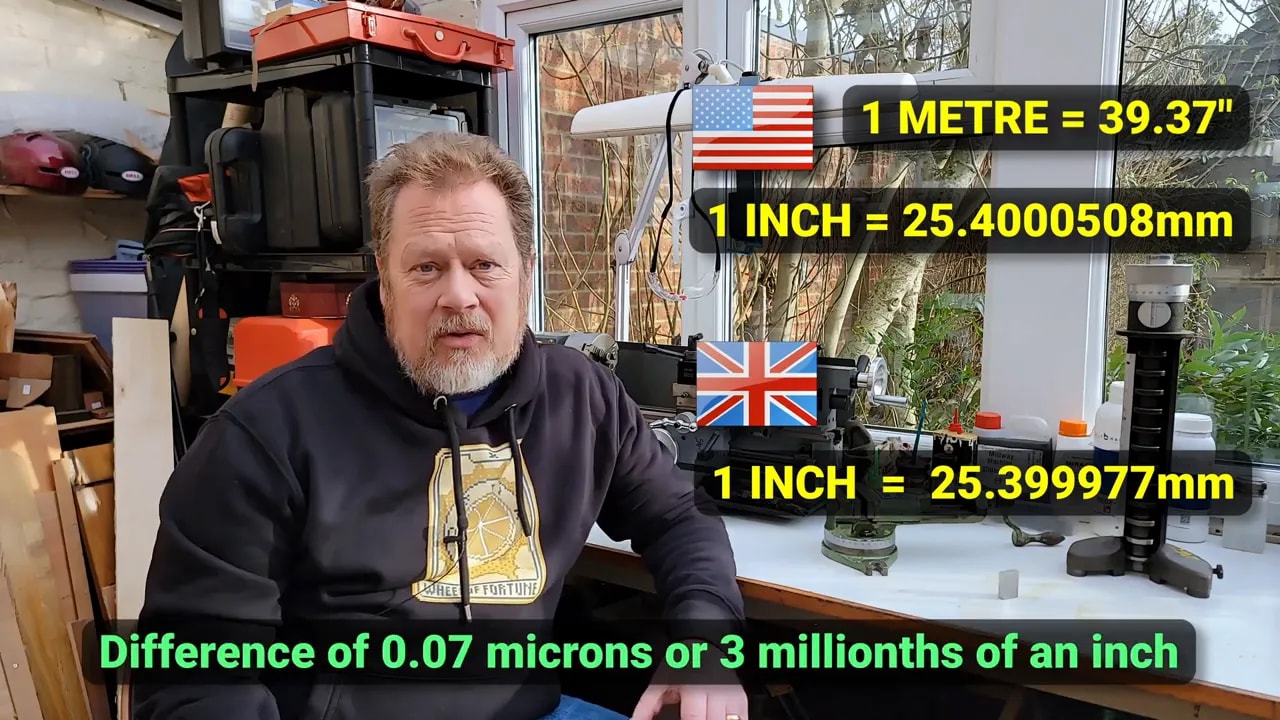
Now before anyone starts panicking and throwing away their micrometers, the difference was minuscule. We are talking about around 0.07 microns, which is about three millionths of an inch.
That is such a tiny discrepancy that for ordinary engineering of the day it barely mattered at all.
Why it did not matter much at first
In earlier periods, especially through much of the Victorian era, plenty of engineering was done by practical fit rather than by chasing vanishingly small numbers. Components were often made to suit one another. A ruler, a scriber, a bit of chalk, and a capable machinist could get a lot done without worrying about millionths.
Even in quite respectable precision work, tolerances were more likely to be in thousandths of an inch or hundredths of a millimetre. If things got especially refined, ten thousandths of an inch might come into play. But widespread international trade in ultra precise interchangeable parts was not yet the norm.
So long as everyone in one workshop or one country used the same standard, the job generally worked out all right.
Then precision engineering made the problem real
The moment these tiny differences started to matter was when measurement itself became much more exact. That is where Carl Edvard Johansson enters the story.
Johansson, the Swedish engineer famous for developing gauge blocks, patented the idea in 1901. These are beautifully accurate reference blocks used to build up known dimensions with extraordinary precision.
If you have ever handled a decent set, you will know they are not just lumps of metal. They are precision standards. Modern sets may be steel, carbide, or ceramic, but the principle is the same. Each block is made to a known size with astonishing accuracy.
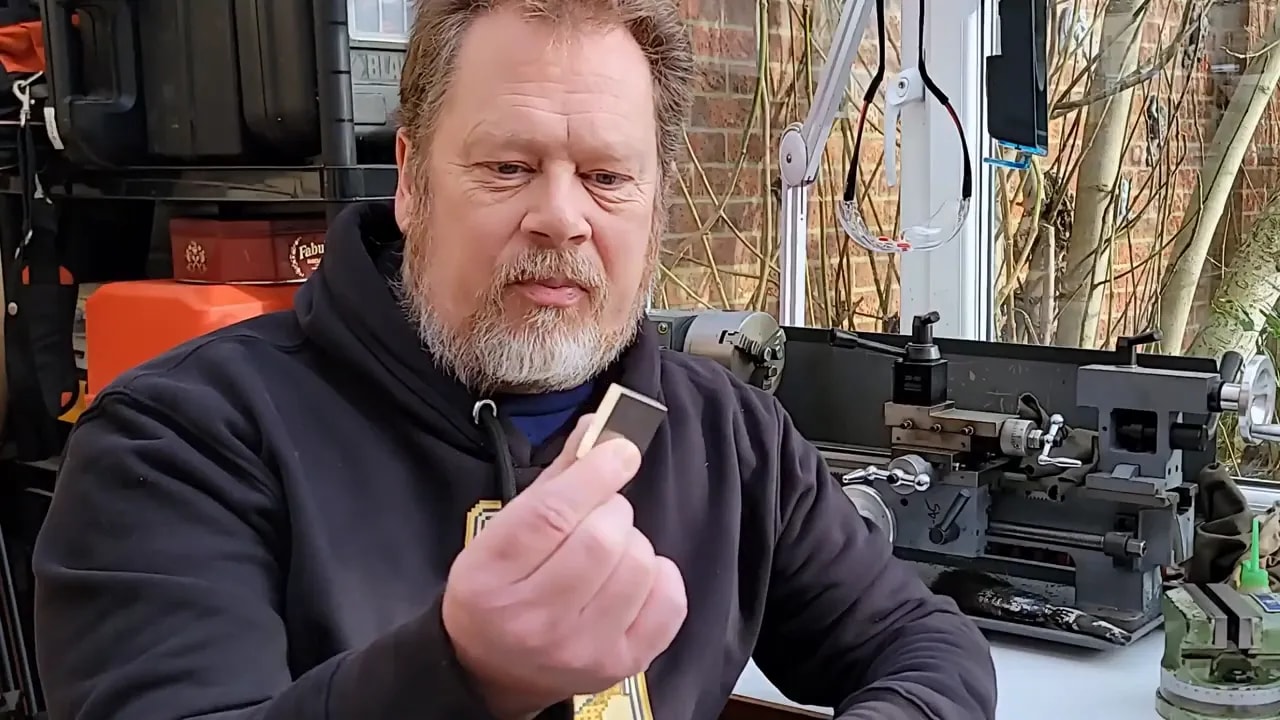
A 25 mm block, for example, is made to be 25 mm on its measuring dimension to a tolerance so tight that most of us would need a lie down after reading it. We are well into the territory of fractions of a micron and millionths of an inch.
And that creates an awkward question.
What size should an inch gauge block be?
If you are making gauge blocks for industry, and industry wants inch sizes, which inch do you choose?
- The US inch based on the metre?
- Or the British inch based on the Imperial Standard Yard?
At everyday workshop scale the gap was tiny. At gauge block scale, where the whole point is absolute repeatable precision, that tiny gap was no longer something you could just shrug off.
Johansson’s brilliantly simple answer
Johansson’s solution was wonderfully straightforward. Instead of siding with one national definition or the other, he simply split the difference.
He treated the inch as 25.4 mm exactly.
That put the value close enough to both the American and British versions to make practical industrial sense. It was a clever compromise, and one of those rare engineering decisions that feels almost too neat.
This became known as the industrial inch, and it spread widely because it solved a real problem cleanly.
How 25.4 mm became the official inch
What began as a practical industrial compromise did not stay unofficial forever.
In 1959, the International Yard and Pound Agreement formally fixed the inch at 25.4 millimetres exactly. That is the modern definition still used today.
So, in a very real sense, the inch we now regard as standard is the result of bringing together earlier competing systems and settling on the sensible middle ground that precision engineering had already proved useful.
Why this tiny historical detail is worth knowing
It is one of those splendid little episodes in engineering history that reminds you standards are not handed down from the heavens on a polished granite surface plate. They are often the result of practical problems, international trade, and someone clever enough to tidy up a mess before it grows teeth.
The difference between the old British and American inch was microscopic, but the story behind it shows how measurement evolves with the needs of industry. When work was comparatively coarse, the mismatch did not matter. Once interchangeable precision parts and high accuracy standards became important, it mattered rather a lot.
And that is often how engineering progresses. Something that is irrelevant at one level becomes absolutely critical at the next.
A final note on “forty thou to the millimetre”
There is one last point worth keeping in your back pocket for workshop conversation.
People sometimes say there are 40 thousandths of an inch in a millimetre. As a rough mental conversion, fair enough. It is handy, quick, and usually close enough for ordinary shop talk.
But strictly speaking, it is not exact.
Since one inch is exactly 25.4 mm, one millimetre works out to about 39.37 thou, not 40. So if someone says 40 thou to the millimetre, they are simplifying, not stating the precise figure.
The short version
- The old US inch was based on the metre, using 39.37 inches per metre.
- The old British inch was based on the Imperial Standard Yard.
- The two differed by only about 0.07 microns.
- That tiny difference became important with high precision engineering and gauge blocks.
- Carl Edvard Johansson resolved the issue by using 25.4 mm for the industrial inch.
- In 1959, that value became the official definition of the inch.
So yes, the inch changed size. Only by a whisker, mind you. But in engineering, a whisker can be the whole story.