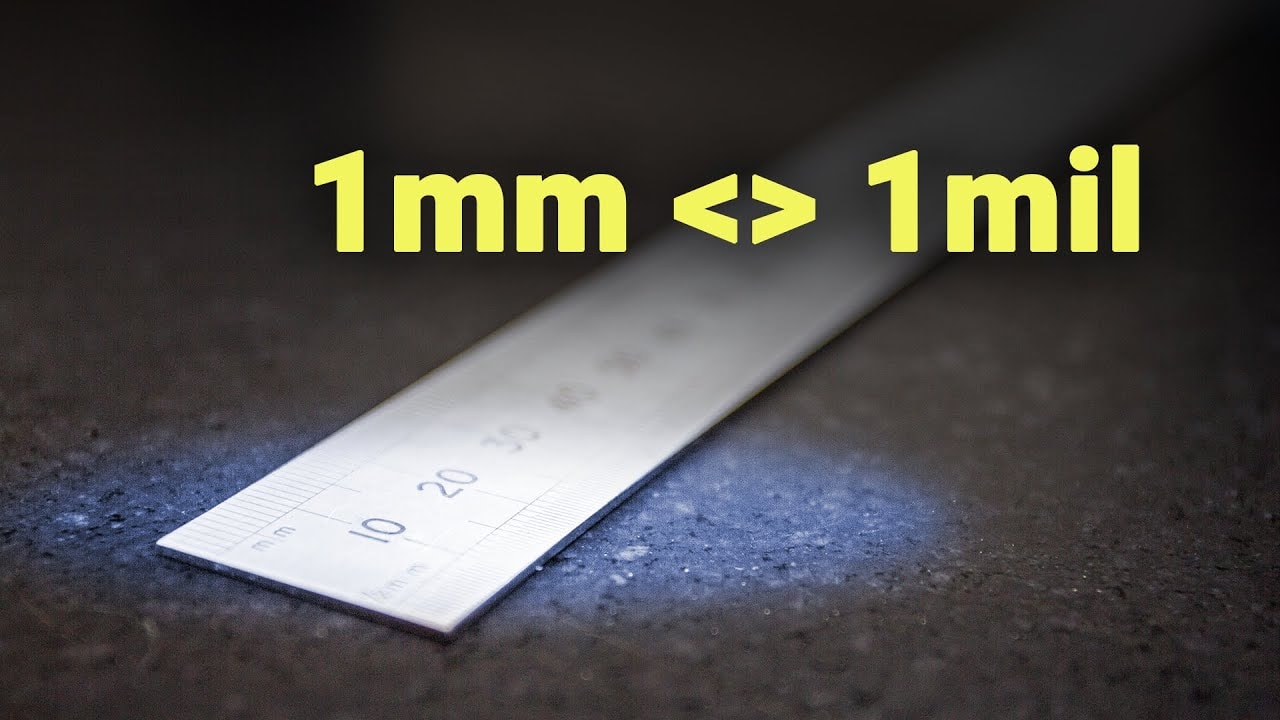

Here is a funny little trap in engineering that can catch you out if you are not careful. I had always assumed that a mil was simply a casual way of saying millimetre. In the UK, that is how many of us use it in the workshop. If a part is 3 mm thick, plenty of us would happily call it 3 mil.
Then I stumbled across the awkward truth that, in other places, 1 mil is not 1 mm at all. In fact, one mil can mean one thousandth of an inch, which works out at 0.0254 mm. That is not a tiny difference in the sense of language. It is a massive difference in practical engineering terms.
If someone asks you to remove two mil from a component, the result could be perfectly correct or completely wrong depending on which side of the Atlantic you are standing.
The UK workshop meaning of mil
In everyday British workshop talk, mil is often nothing more than a shortened way of saying millimetre. It is unofficial, casual, and convenient. After all, millimetre is not exactly the shortest word in the English language.
So if a piece of stock is 5 mm thick, it would not be unusual to hear someone call it 5 mil. That usage feels completely natural if you have spent years around metric engineering.
The problem is that this shorthand can lull you into thinking everyone means the same thing. They do not.
The North American meaning of mil
In North America, mil is also used as a proper unit of length, and it means 0.001 inch. In other words:
- 1 mil = 0.001 inch
- 1 mil = 0.0254 mm
That means:
- 5 mil in the North American sense is 0.127 mm
- 5 mil in the casual British sense is 5 mm
Those are nowhere near each other. One is a fine tolerance. The other is a substantial lump of metal.
That is why this matters. It is not a pedantic language point. It has real consequences in machining, fitting, tolerancing, and drawing interpretation.
How this confusion came to light
This only really clicked for me for two reasons.
First, someone queried my use of the word mil and asked whether I meant millimetres. My initial reaction was basically, what else would I mean? That question planted the seed that perhaps not everybody heard the word the same way.
The second thing that really brought it into focus was a long engineering rabbit hole involving the Challenger Space Shuttle hearings. There is a great deal to learn from that whole episode, not only about engineering but also about judgement, communication, and ethics.
During the hearings, one of the NASA speakers referred to an O-ring being five mil undersize. At first glance, if you are thinking in casual British metric workshop terms, five millimetres sounds absurdly large for an O-ring tolerance.
That was the clue. Something was plainly off. Once you realise the speaker meant five thousandths of an inch, it makes sense.

Why this is more than a curiosity
Engineering depends on precision, and precision depends on shared definitions. If two people use the same word to mean different quantities, trouble is never far away.
Imagine a British engineer working in an American shop. If someone says, “take two mil off that diameter,” the intended cut might be:
- 2 mm if heard in the British shorthand sense
- 0.002 inch, or about 0.0508 mm, if meant in the North American sense
That is the difference between a modest skim and a proper reduction. You would not want to find out which one was intended after the part has already been machined.
It is a good reminder that clear unit language matters, especially when drawings, tolerances, specifications, or international teams are involved.
Do engineers in the USA still say mil?
That is an interesting question. In metric circles, especially here in Britain, mil as shorthand for millimetre still turns up readily enough. In the United States and Canada, mil has this established inch-based meaning, so it makes you wonder whether people avoid the term in mixed environments to prevent confusion.
It would make perfect sense if many shops preferred to say thou, thousandths, or simply wrote dimensions clearly enough that there is no ambiguity. Equally, there are bound to be sectors where mil remains common because everyone in that field already knows exactly what it means.
The lesson for the rest of us is simple. Never assume. If the context is international, ask.
Mil does not only refer to length
Just to make matters slightly more entertaining, length is not the only thing that mil can mean.
Mil as an angular measurement
If you have ever dealt with telescopic sights, rangefinding, or military mapping, you may have come across mil used as a unit of angle.
In that setting, a mil is related to the milliradian, often written as mrad. A milliradian is one thousandth of a radian. It is very useful for angular measurement and practical estimation over distance.
That usage is entirely separate from both millimetres and thousandths of an inch, which gives the word yet another life of its own.
Mil as a currency unit
There is also a financial use. In some North American contexts, a mil can refer to one thousandth of a dollar. That turns up in certain specialist transactions and areas such as energy pricing where values may be carried to three decimal places.
Again, it is not a length measurement, so the chance of confusing it with a machine shop instruction is fairly low, but it does show how slippery short unit words can be.
Where the word comes from
The root of the word is tied to the idea of a thousand. It comes from the same linguistic family that gives us words associated with large counted quantities and long spans of time.
That helps explain why mil often appears in contexts involving one-thousandth divisions, whether that is:
- a thousandth of an inch
- a thousandth of a radian
- a thousandth of a dollar
It does not, however, solve the workshop confusion where one person uses mil as shorthand for millimetre and another uses it as a specific thousandth-based unit.
How to avoid expensive misunderstandings
There is a simple way to sidestep this sort of muddle.
- Say mm when you mean millimetres.
- Say thou, thousandths, or 0.001 inch when working in imperial fine dimensions.
- Write units explicitly on drawings, notes, and setup sheets.
- Be especially careful when working across countries, suppliers, or online discussions.
Most workshop mistakes are not caused by a lack of skill. They are caused by assumptions, rushed communication, and little ambiguities that seem harmless until a cutter touches metal.
A small word with a rather large sting in the tail
For such a short word, mil carries quite a lot of baggage. In one place it may mean a millimetre in casual speech. In another it means a thousandth of an inch. Elsewhere it is a unit of angle, and somewhere down the line it can even be part of financial notation.
So the next time someone says, “take a couple of mil off that,” it might be wise to pause before reaching for the handle. The difference between 2 mm and 0.002 inch is not the sort of thing you fix with a bit of emery and optimism.
And yes, sometimes we do say millimetres in full. Usually when we are being paid by the hour.