
A Stanley No.5 Jack Plane is one of those thoroughly useful tools that deserves a place in a proper home workshop. It is big enough for flattening and stock preparation, manageable enough for ordinary bench work, and common enough that a tired example can often be had for sensible money.
This particular Stanley No.5 Jack Plane cost £20 at a car boot sale. It had the usual rather unpleasant black resin handles, which have since been replaced with English elm totes finished in Danish oil. The cast iron body, however, had two more serious issues. Its sole was very rough and it was distinctly bowed.
Rather than lap it in the usual woodworking fashion on abrasive paper over a flat reference surface, I used an old school engineering method: hand scraping. To be clear, this is not necessary for making a perfectly serviceable plane. Abrasive paper on float glass or another known flat surface remains an entirely sensible method. This was partly an excuse to practise hand scraping on a nice lump of cast iron, and partly an opportunity to turn a rough old plane into a rather lovely tool for life.
Why Hand Scrape a Stanley No.5 Jack Plane?
Hand scraping is traditionally used to produce accurate sliding surfaces on machine tools. It is especially well suited to cast iron, which scrapes pleasantly and predictably compared with many other metals.
The finish is not merely decorative, although it does look splendid. A scraped surface consists of a great many tiny high points and hollows. The height difference between them can be only a few ten thousandths of an inch, yet the texture reduces the effective contact area. On machine slides that helps retain lubricant and reduces stiction. On a Stanley No.5 Jack Plane, it should help the sole glide smoothly over timber rather than feeling as though it has been dragged down the A10 behind a Reliant Rialto.
The later English-made plane had a rough ground sole, unlike an older Stanley No.4½ used for comparison. The older plane showed neat, continuous machining marks, likely from a planer shaper. The No.5 had an untidy ground finish with obvious irregularities, sufficiently rough to catch on wood and make sideways adjustment rather unpleasant.
So there were three good reasons to tackle it:
- The sole needed flattening to make the plane work properly over a long board.
- The rough grinding needed replacing with a smooth, low-friction finish.
- A cheap cast iron Stanley No.5 Jack Plane makes a very cost-effective scraping practice piece.
Measuring the Original Sole
Before removing any material, it is worth knowing what is actually wrong. The first check was with a known straight edge and feeler gauges. The iron was wound fully back so it could not influence the measurement.
With the straight edge placed along the sole, light was visible beneath the middle. Feeler gauges confirmed that the sole had high ends and a low middle. A 0.15 mm feeler gauge could just be introduced in places, which is roughly 0.006 inch, or six thou.
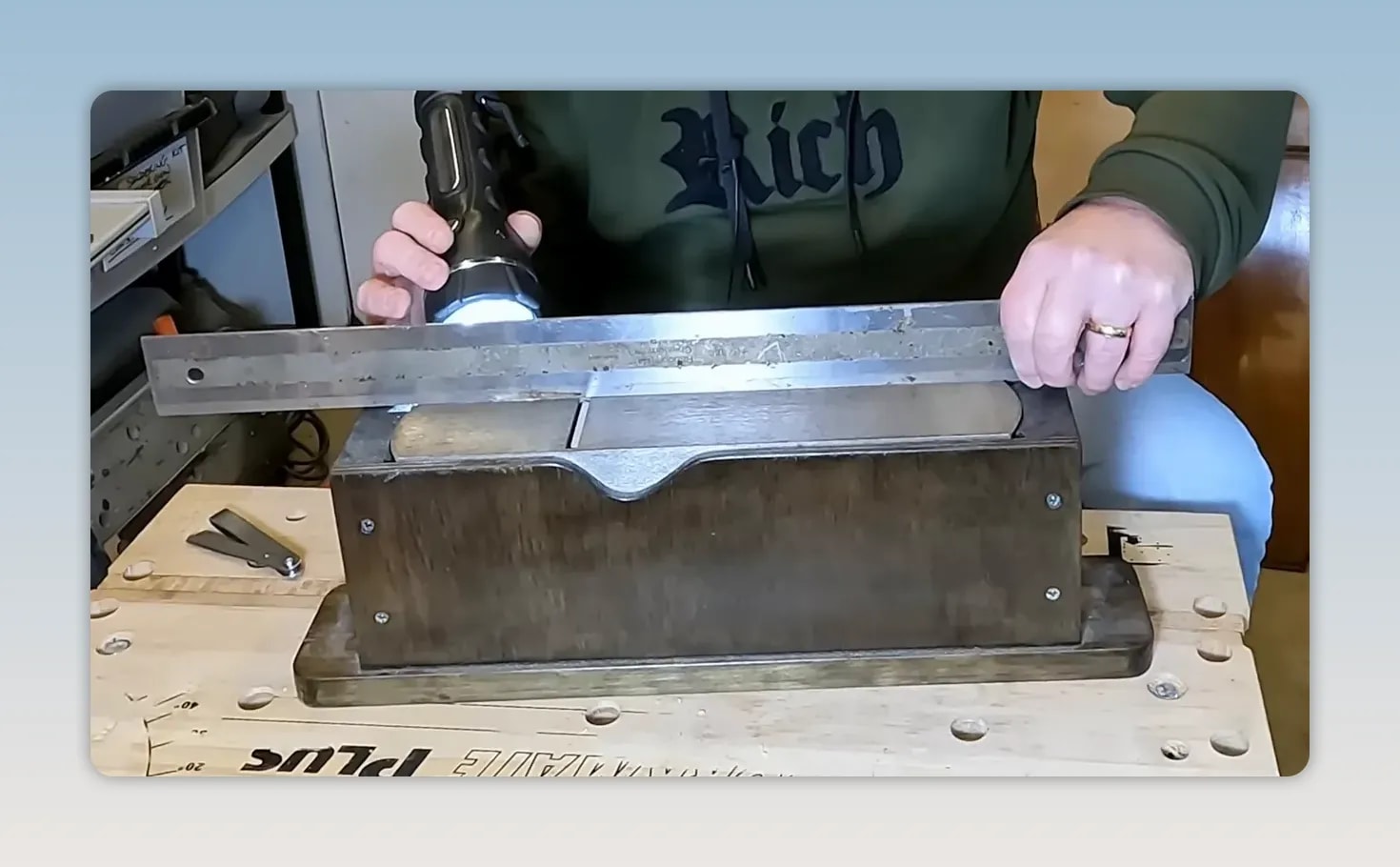
That may sound trifling, but a plane can take shavings around 0.002 inch thick. A sole bowed by 0.006 inch affects how the blade meets the timber throughout the stroke. A plane may start cutting heavily then progressively take less, or fail to cut where it ought to. British standards commonly put the expected flatness of a plane sole at about 0.001 inch, so this Stanley No.5 Jack Plane was well outside that figure.
A More Engineering-Style Measurement
The second check used a 300 mm by 300 mm granite surface plate, precision parallels, and a dial indicator on a surface gauge. The plane rested across two equal-height parallels, placing its sole parallel to the surface plate. Sweeping the dial indicator along the sole then showed the height variation directly.
The reading rose from zero at one end to around 0.010 inch near the mouth before returning towards zero at the other end. This did not contradict the feeler-gauge test. It exposed the roughness and local humps more clearly, especially around the mouth where the original grinding was particularly coarse.
None of this measuring kit is required to flatten a woodworking plane, mind. It is very much the engineering version of bringing a sledgehammer to crack a walnut, but it does show exactly what is happening.
The Scraping Process: Blue, High Spots, Scrape, Repeat
The heart of hand scraping is simple. A very thin film of engineer’s marking blue is spread over a known flat surface plate. The Stanley No.5 Jack Plane is then placed gently onto the blue and moved lightly under its own weight. It is important not to press down. The blue transfers only to the areas touching the reference surface, revealing the high spots.
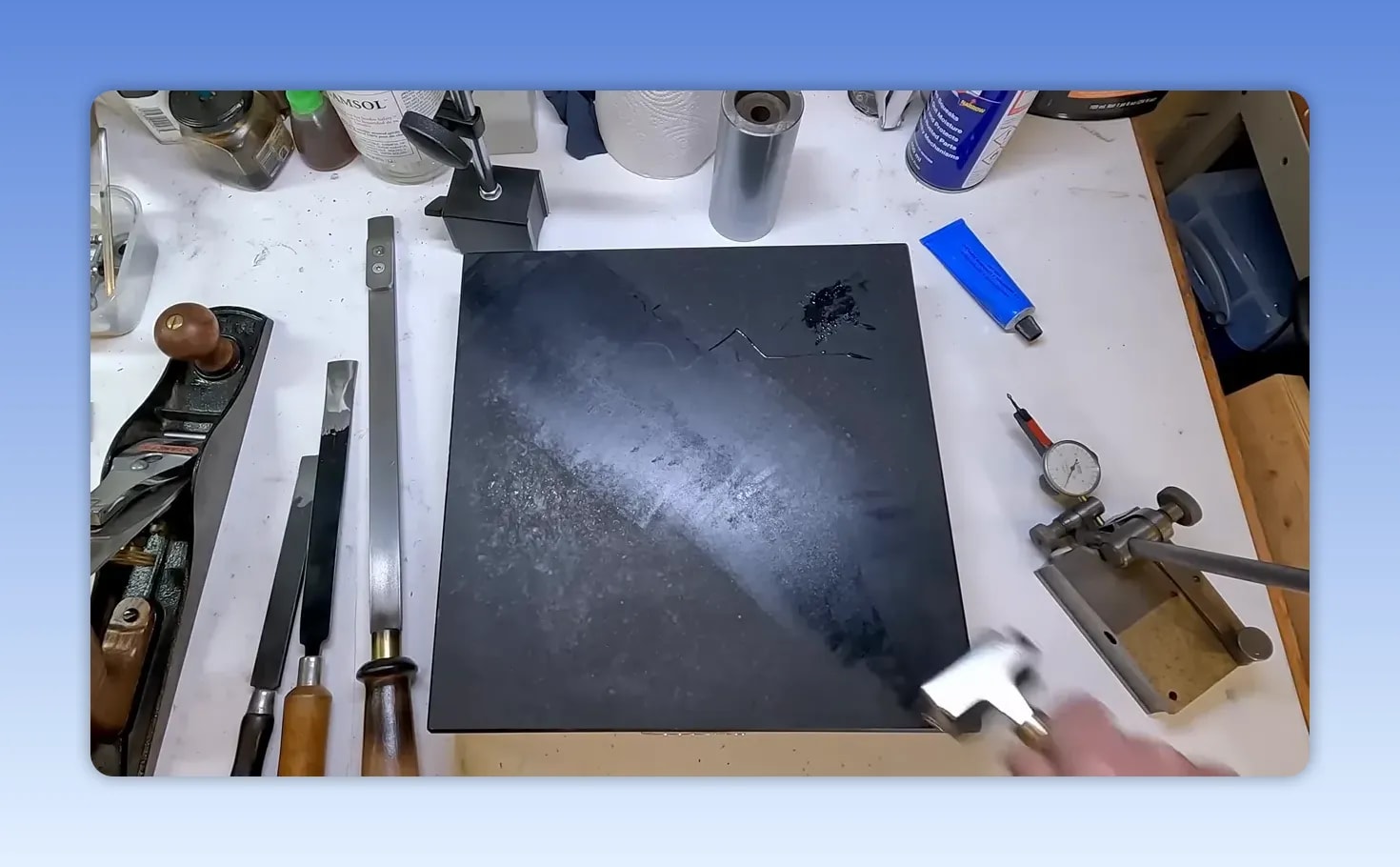
At first contact, this plane was dreadful. Blue appeared only in a few isolated spots. The sole was bowed lengthways and had a hollow across its width too. The blue was not a finish to admire at this point. It was a map of where material had to come off.
The process then became a steady cycle:
- Apply a thin, even film of marking blue to the surface plate.
- Rub the plane very lightly over the plate.
- Lift it straight up and inspect the blue transfer.
- Clamp the plane securely in a shaped wooden shoe.
- Scrape the blue high spots away with a hand scraper.
- Brush away swarf, remove burrs with a fine oilstone, and repeat.
For the initial roughing work, the scraper was used in overlapping strokes and then approached from a second direction at roughly 45 degrees. Changing the angle helps prevent a collection of long furrows forming in the work. It is rather repetitive, but there is something quite therapeutic about it once the first few alarming blue patterns have passed.
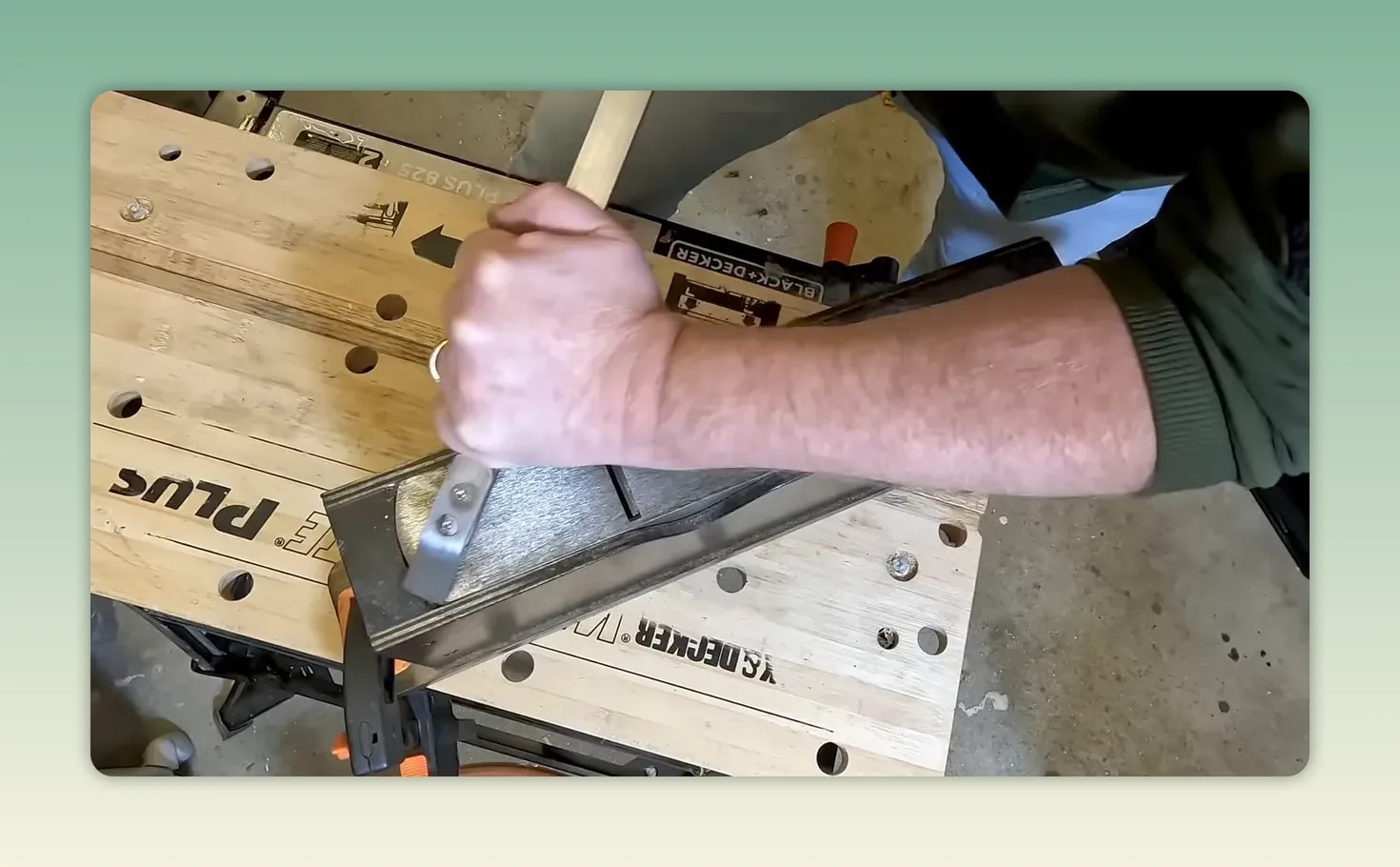
Keep the Plane in Its Working Configuration
One important practical detail is easily missed. The wooden totes were removed to keep the English elm away from blue, iron dust and grubby mitts, but the frog, cap iron and blade assembly stayed in the body.
Cast iron may feel immensely rigid, but a plane casting can move slightly when its internal parts are removed or tightened. If the sole were scraped perfectly flat as a bare casting, then the frog and iron fitted afterward, the body could spring or distort enough to lose some of that accuracy. The Stanley No.5 Jack Plane was therefore scraped in its normal working condition, with the blade retracted safely inside the mouth.
Reading the Blue Pattern as the Surface Comes In
After the first few passes, blue began to spread from isolated patches into larger areas. That is exactly what should happen. Each group of blue marks represents points at the same height relative to the surface plate. As the high spots are reduced, lower areas gradually join them.
After about 15 minutes of fairly vigorous roughing, there was already a recognisable pattern across both the toe and heel. The central hollow was still there, but the bow was diminishing and the contact points were much more evenly distributed.
Another 20 minutes of work brought the original 0.15 mm gap down to around 0.05 mm, or approximately 0.002 inch. At that stage, the Stanley No.5 Jack Plane was already near the usual woodworking requirement for flatness, but it was worth continuing for the uniform scraped texture and the satisfaction of finishing the job properly.
As accuracy improves, use less marking blue. A heavy coat is helpful when the surface is very uneven because it makes initial contact easy to see. Once the sole is close, a thick film disguises detail. A very thin transfer reveals the remaining low areas far more clearly.
Scrapers and Other Useful Kit
The essential item is a genuinely flat reference. In this case it was a small granite surface plate, around 12 inches square, with a stated flatness of just under three microns. A modest plate of that sort is not outrageously expensive, though it is certainly more kit than most people need for one plane.
The working setup included:
- A granite engineer’s surface plate.
- Engineer’s marking blue.
- A firm, smooth printer’s roller for spreading the blue.
- A shaped wooden shoe to hold the plane upside down.
- A hand scraper.
- A soft brush to remove chips and iron dust.
- A fine oilstone with mineral spirit to remove burrs.
- A straight edge, feeler gauges, parallels and dial indicator for checking progress.
Steel Versus Carbide Scrapers
A basic steel scraper is perfectly capable of flattening a Stanley No.5 Jack Plane. Old scrapers often turn up at car boot sales, flea markets, or online. They can be reground on an ordinary grinding wheel and honed on a conventional stone. The drawback is that steel goes blunt quite quickly when scraping cast iron. On a large plane, it may need sharpening several times during a pass.
A carbide-tipped scraper is much more durable. The carbide insert lasts far longer and can often be rotated to expose another cutting edge. For regular scraping it is a worthwhile investment. Carbide does demand appropriate sharpening equipment, generally a diamond wheel for a fine edge, so it is not quite as simple as a bit of steel.
For a one-off project, a steel scraper is enough. For a regular habit of scraping machine parts, planes or other castings, carbide becomes rather more attractive.
Refining the Sole and Flattening the Sides
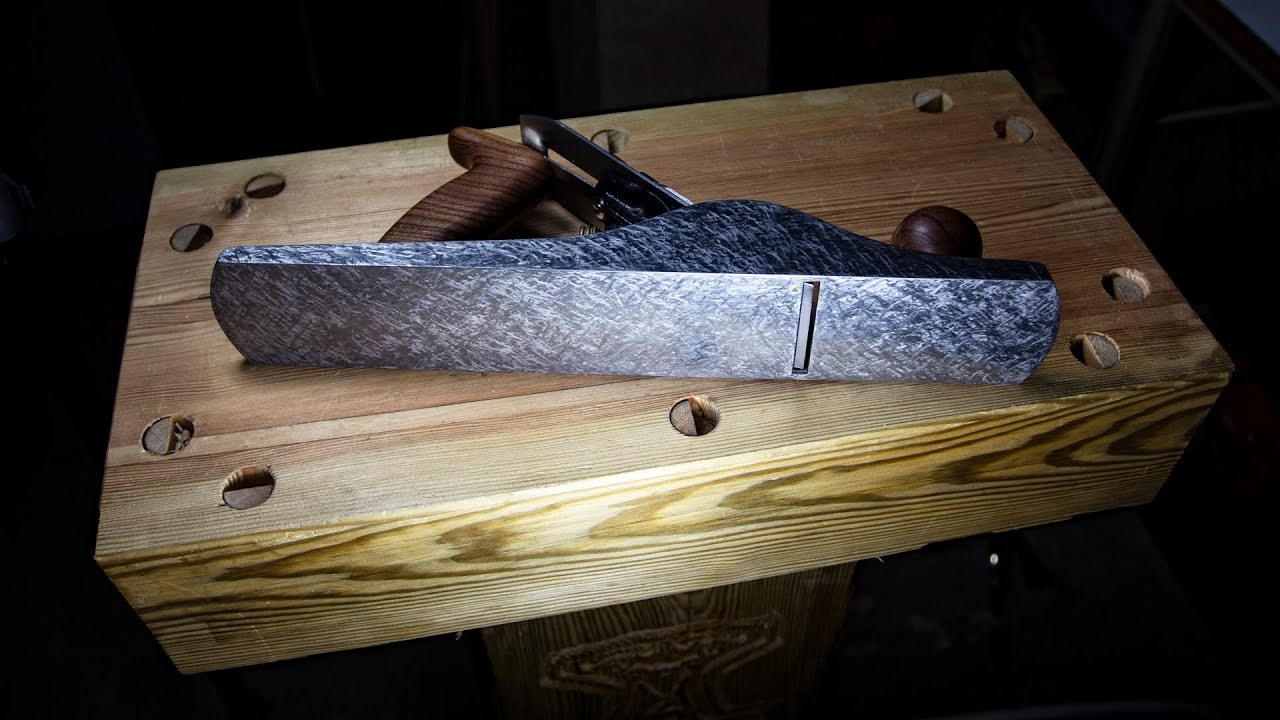
As the work progressed, the sole changed from coarse grinder marks to a pearly, stippled surface. It can look rather dented from a distance, but that is deceptive. The difference between the bright high spots and darker hollows is on the order of 0.0001 inch. The result is dead smooth to the touch.

The sides were also checked and lightly scraped. A plane side is not normally a working surface, but it is often used as a convenient straight edge when assessing a board. On this Stanley No.5 Jack Plane, one side kicked out by roughly 0.25 mm at the front. That is not catastrophic, but it could create a false daylight gap when checking timber. Flattening the sides removed that little doubt.
The Final Accuracy Check
The finished plane went back onto the granite plate, supported on its two parallels, and the dial indicator was swept carefully along the sole. Tiny fluctuations appeared as the probe crossed the individual scrape marks, which is to be expected. The objective was the average plane of the surface, not an imaginary mirror finish.
Around the mouth there were still remnants of the original grinding marks, creating some local movement of the needle. Away from that area, the reading hovered very close to zero. The final overall variation was approximately 0.0002 inch, which is about 0.005 mm or five microns.
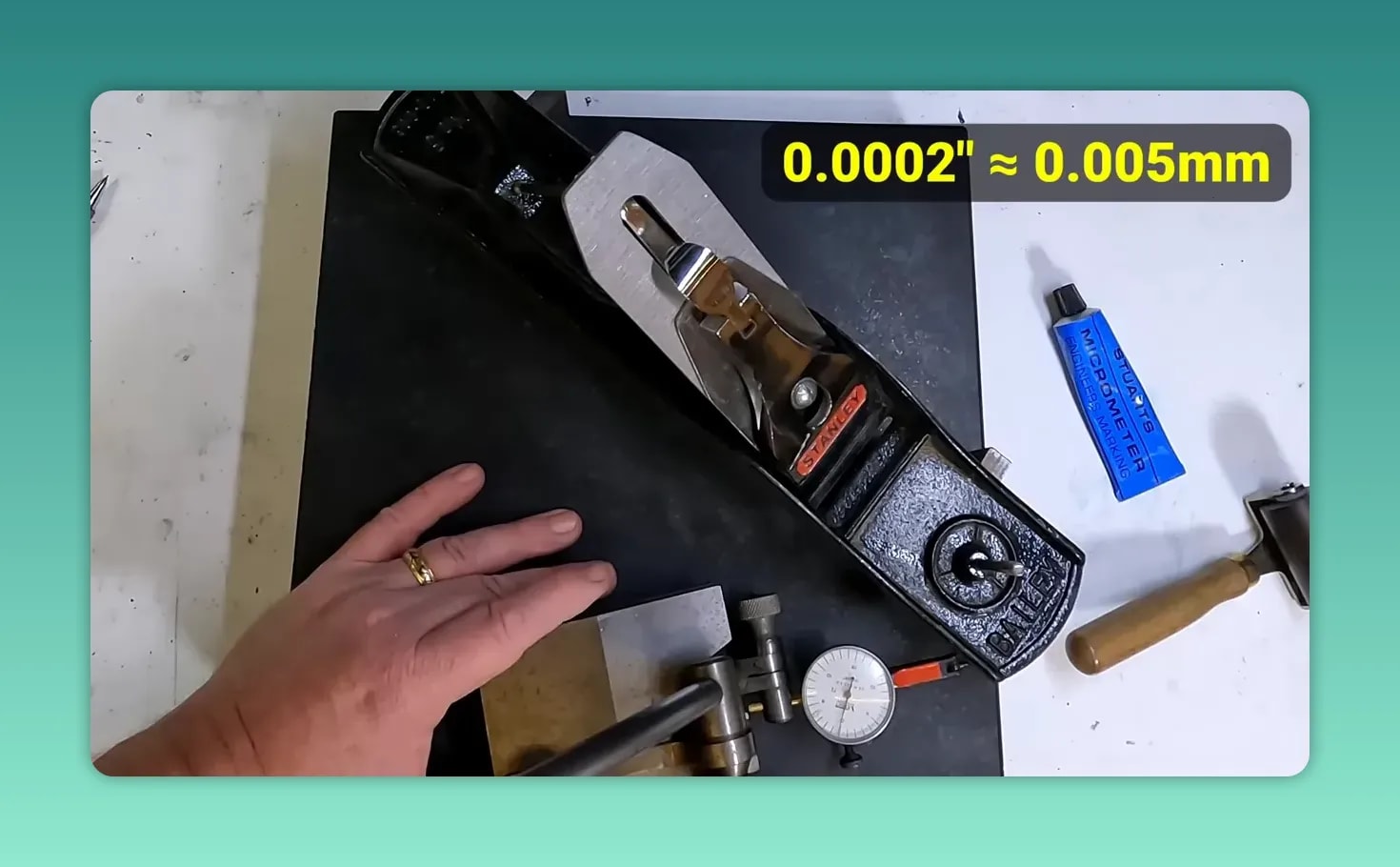
That is a substantial change from the original 0.15 mm, or six thou, gap. More importantly, the Stanley No.5 Jack Plane now has a sound, consistent sole that should behave properly across a board.
Was Hand Scraping a Stanley No.5 Jack Plane Worth It?
Strictly speaking, no woodworker needs to scrape a plane sole to two ten thousandths of an inch. A good lapping job on abrasive paper over a flat substrate will produce a very capable tool, and it will do so more quickly.
But that is not quite the point. Hand scraping links traditional metalworking and traditional woodworking in a wonderfully practical way. An old, rough, inexpensive Stanley No.5 Jack Plane becomes an excellent cast iron practice piece, and at the end of it there is not a sacrificial exercise but a handsome, useful hand tool.
This particular £20 find now has smooth elm handles, flattened sides, a genuinely flat sole and a lovely silky scraped finish. It is not merely a restored old plane. It is a proper workshop companion, ready for another few decades of honest work.